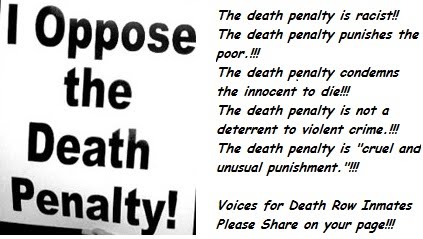
Voices for Death Row Inmates Banner of Hope

Voices for Death Row inmates got together with London artist Carrie Riechadrt and came up with the idea of a Hankies for Hope banner ... this banner is made from cotton hankies .. hankies being something we wipe tears of sadness away with. During the time the death penalty was in practice in the United Kingdom, the judge when passing a death sentence would place a black hankie on his head as he did so .
Each hankie represents a soul , a soul awaiting their fate or already executed . The name, prison ID number and State is written on the hankie. There are also birds flying free. Bird cages ,hearts , angels , candl
es , leaves and flowers painted onto the banner, again all symbolic.
They have been stitched together with orange ribbons between each one , orange being the colour of oppression and the colour of the jumpsuit a death row inmate wears when being moved from one place to another ... so this banner is very symbolic in everyway
This banner has grown over the last few months …but we want people to add the names of their loved ones and pen pals to the Banner of Hope.

If you would like to add a name of an inmate who has been executed or is on death row please contact us via our facebook page or via our website
Below see our Banner of Hope SO FAR!! More names will be added soon


The Banner of Hope So far

Translate

Friday, 18 January 2013

How many innocent people has the US executed?

As a report reveals the innocence of a man put to death in Texas in 1989, we examine the US' use of capital punishment. More than two decades after the US state of Texas executed Carlos DeLuna, an investigative study has revealed that he was in fact innocent. DeLuna was put to death in 1989 for stabbing and killing a petrol station cashier, Wanda Lopez, in 1983. Now a team from Columbia University claim to have proven DeLuna's innocence. James Liebman, a law professor, and his students say DeLuna's conviction was the result of a poor police investigation, unreliable eyewitness testimony and a weak defence. "There was no DNA that was ever found or used in this case. [The] team went to Corpus Christi in 2003 to try to get the physical evidence from the case to run a DNA analysis but that physical evidence had been checked out of the prosecutor's office and lost." - Shawn Crowley, the co-author of Los Tocayos Carlos Their report concluded that the murderer was Carlos Hernandez, a man who bore a striking resemblance to DeLuna. Over the last two decades support for capital punishment in the US has been on the decline. Nonetheless, despite the work of many groups that have raised questions about the fairness of the American justice system, around 60 per cent are still in favour of the death penalty. Today, there are more than 3,200 people on death row. So far this year, 18 people have been executed. But the number of death sentences is dropping every year, and more than a dozen US states have now abolished capital punishment. Death penalty opponents say there is no way to know how many innocent people have been executed in the US. Over the last 40 years, more than 130 have been released from death row. "If I was to rewrite the laws I would add many procedural safeguards against the possibility of making [an] error, like requiring DNA, changing the standard of proof from beyond a reasonable doubt to any doubt whatsoever and requiring a [competent] defence lawyer…." - Bruce Fein, a constitutional lawyer Nate Fields is among those exonerated inmates. In 2009, he was acquitted of a double murder after spending almost 20 years in prison, including more than 11 years on death row. Among other things, this is what Fields told Al Jazeera after reading about Columbia University's investigation into the DeLuna case: "The main reason why the death penalty should be abolished is because of the human factor and that is going to continue to play out as long as we have the death penalty. As humans we are going to make mistakes. Just because there are 12 people in the jury doesn't mean they can't get it wrong, they can …because of the human factor …. With the death penalty you can't bring a man back from the graveyard." So, what are the flaws in America's implementation of capital punishment? Joining presenter Shihab Rattansi on Inside Story Americas to discuss this are guests: Shawn Crowley, the co-author of Los Tocayos Carlos, the report that seeks to establish that Carlos DeLuna was innocent; Bruce Fein, a former US associate deputy attorney-general and a constitutional lawyer; and Richard Dieter, the executive director at the Death Penalty Information Center. "Most of our criminal justice system is based on plea-bargains and compromises but the death penalty once it's carried out can't be taken back, we have no room for error so it is a systemic problem as well as a procedural one." Richard Dieter, the executive director at the Death Penalty Information Center THE CARLOS DELUNA CASE: DeLuna was accused of killing a petrol station clerk, Wanda Lopez, in 1983. He was executed in Texas in 1989 A Columbia Law School report on the execution found significant problems with the conviction, particularly that it was based on the testimony of a single, unreliable eyewitness The report says another man had admitted to killing Lopez, that DeLuna had an ineffective defence lawyer and that he had suffered during his execution due to a problem with the injection The five-year investigation into DeLuna's case found him not guilty of the crime he was executed for, and suggested that police had botched the investigation THE DEATH PENALTY IN THE US: More than 3,200 people remain on death row About 60 per cent of Americans support the death penalty, although support has dropped in the last 20 years So far 18 people have been executed in 2012, while 43 people were executed in 2011 More than 1/3 of all executions took place in Texas, which has executed 482 people since reinstating the death penalty in 1982 Out of the 50 US states, 17 have abolished the death penalty China, Iran, Saudi Arabia and Iraq conducted the most executions in 2011, the same year the US ranked fifth worldwide The US is the only Western country that imposes the death sentence Source: http://www.aljazeera.com/programmes/insidestoryamericas/2012/05/2012518112115143387.html

STOP the execution of Kimberly McCarthy

The family, friends and supporters of Kimberly McCarthy are petitioning Governor Rick Perry and the Texas Board of Pardons and Parole in effort to save Kimberly from being put to death by the State of Texas. Kimberly suffered from a severe addiction to crack cocaine in the 1990's, and her life went into a downward spiral, into the underworld of drugs. Her association with the wrong people coupled with her out of control drug use became a lethal combination which led to tragedy. Prior to her drug use Kimberly had no criminal record and was in the field of helping and healing the sick as an occupational therapist! When she was introduced to drugs her life took a dark and destructive turn that led to tragedy! A tragedy that she lives with daily and is deeply remorseful for. Over the years Kimberly's faith in God has strengthened. Her spirit and personality touch each and every person she encounters. We are asking that Kimberly's sentence be commuted. That the State of Texas show mercy!! Killing Kimberly will not bring the victim back. It will only create more suffering and heartache. More victims. She could be such a positive influence to others. God can use her to touch the lives of other women headed down the road to destruction. Sincerely PLEASE SIGN THE PETITION: http://www.change.org/petitions/stop-the-execution-of-kimberly-mccarthy

We Will NOT be SILENT

We Oppose the Death Penalty

Friday, 26 October 2012

A Death Row Struggle Between Advocates and Lawyers

Spencer Selvidge for The Texas Tribune Preston Hughes III in Livingston, where he is on death row. He was convicted of the 1988 stabbing of a teenage girl and a 3-year-old boy in Houston. LIVINGSTON — Preston Hughes III, a death row inmate, is 46 but seems much older, with white hair, thick glasses and a quiet, slow voice that rises only when the subject of his lawyer comes up. Mr. Hughes, convicted in 1989 of fatally stabbing two young people, has tried multiple times to dismiss his court-appointed lawyer, Patrick McCann. He said that Mr. McCann, who has been his lawyer for 14 years, had not raised his claims of innocence and is “helping the state cover this up.” Mr. McCann says he cannot comment on why he will not pursue these claims, which were not introduced in Mr. Hughes’s original trial. But Texas and federal law set a high burden of proof for new claims of “actual innocence” so late in the judicial process, a bar that Mr. McCann said was “almost impossible” to meet. Mr. Hughes, who says he did not commit the murders, is scheduled to be executed Nov. 15. He says all of his lawyers have failed him. “They just want to do things on their own,” he said recently from death row in Livingston. While Mr. McCann is suing the state over lethal injection procedures, arguing that prison officials would be “experimenting” on his client, a handful of advocates are publicizing what they believe is new evidence of Mr. Hughes’s innocence. The advocates, who do not have legal training, are campaigning for Mr. Hughes’s exoneration and supporting his efforts to have Mr. McCann fired. The issue of advocates’ doubting the work of lawyers is common in death penalty cases, especially as an execution date nears. “Once the lawyers do the spadework, a lot of people want to come in,” said Jeff Blackburn, a lawyer who runs the Innocence Project of Texas, “and they don’t understand that we’re limited with the art of the possible here.” He called Mr. McCann a “great lawyer.” The official facts of the crime, on their face, pointed directly to Mr. Hughes. On the night of Sept. 26, 1988, Shandra Charles, 15, and her cousin Marcell Taylor, 3, were fatally stabbed in a Houston field. A police sergeant reported that before she died, Ms. Charles identified the name “Preston” and said, “He tried to rape me.” Detectives located Mr. Hughes in a nearby apartment complex. Investigators found evidence of blood on his clothing and a knife in his apartment, as well as Ms. Charles’s eyeglasses on his couch. Mr. Hughes, who said the glasses were planted, confessed to the murder during the investigation but then denied involvement during the trial. No biological evidence tied him directly to the crime. Convicted and sentenced to death in 1989, Mr. Hughes had multiple appeals rejected. Then, this year, several unlikely advocates became interested. John Allen, 64, a retired engineer in California, writes a blog called The Skeptical Juror. With the help of Barbara Lunsford, an accountant in Corpus Christi, and Ward Larkin, an activist from Houston, he has spent nine months and more than 100,000 words delving into the forensic and legal details of Mr. Hughes’s case. None of the three are affiliated with an official organization, and while Mr. Allen has written about other convictions in the past, he said he had stopped looking at other cases for now. After reviewing documents related to the trial, appeals and evidence, he deduced that Ms. Charles must have lost brain function within two minutes, and she could not have told the police the name of her attacker. “This is a seemingly overwhelming case” of innocence, Mr. Allen said, adding that he also believed that the victim’s glasses were planted in the apartment, based on his review of crime scene photographs. In September, Mr. McCann said he had never heard of Mr. Allen’s investigation. This week, he said Mr. Allen “sounds like a very sincere man who is attempting to right a wrong.” “Like in fantasy football,” he said, “I think lots of people are happy to offer thought without skin in the game.” As for Mr. Hughes’s petitions to have him replaced, Mr. McCann said he thought they were the product of desperation. “When a person is drowning,” he said, “they sometimes try to fight the guy holding a life preserver.” Mr. McCann agreed that Ms. Charles would have “been unconscious in a matter of seconds based on the blood loss,” and so she could not have said Mr. Hughes’s name to the police. Despite being troubled by this evidence, he is not filing a claim of innocence. “I find myself in an odd position,” he said, “because I’m ethically bound not to advance a claim I think is false.” Mr. Allen learned about the case while investigating the work of James Bolding, the head of blood analysis for the Houston Police Department’s crime lab at the time, who testified at Mr. Hughes’s 1989 trial. Mr. Bolding tested for blood on Mr. Hughes’s knife while he was in the courtroom. Mr. Hughes said the blood came from a rabbit he had killed months before. Judge George Godwin said at the time that he found the “cavalier attitude and lackadaisical attitude of doing tests right while we’ve got a jury waiting to come in and hear testimony unacceptable.” He nevertheless ruled that the testimony was permissible. Mr. Hughes said he trusted Mr. Allen more than his lawyer, Mr. McCann. In September, Mr. Hughes filed a petition to have Mr. McCann replaced, and a court rejected it. Mr. McCann plans to follow the case to the end. In September, he sued the Texas prison system, saying that by using a single drug for the execution, as a result of a recent policy change, officials would be experimenting on his client. The Court of Criminal Appeals, Texas’ highest criminal court, has ordered the civil court overseeing the case not to stay Mr. Hughes’s execution. Mr. McCann does not know when the court will rule. “The unfortunate timing of this is it’s before a contested election,” he said. Murray Newman, a Houston defense lawyer, said he believed Mr. McCann was doing his best and cared about Mr. Hughes. “He works so hard on these cases. It’s like losing a family member,” Mr. Newman said. From death row, Mr. Hughes sees it differently, as he plays basketball during his hour of recreation every day, eats food he calls “pitiful” and learns about court decisions from a small, black radio. “We don’t like each other,” he said of Mr. McCann. “I don’t feel somebody who doesn’t like me is going to do anything for me.” mchammah@texastribune.org A version of this article appeared in print on October 26, 2012, on page AX of the National edition with the headline: A Death Row Struggle Between Advocates and Lawyers.

Voices for Death Row Inmates Yahoo Mail Group

Subscribe to Voicesfordeathrowinmates

Powered by us.groups.yahoo.com